So...is online activism/hacktivism the future? Or is it already the present?
I think that online activism has been being developed for several years but has grown strong after the appearance of social networks, which made it possible to gather people together and raise a voice agains the wrongdoings of governments and politicians. I just have to remember that in the already mentioned Spanish movement people would meet in the streets in small communities and discuss about things that affected the neighborhood.
And what about e-democracy? Is it a real possibility and how can we manage to do it properly? As said in James Cabree's article, Civic hacking: a new agenda for e-democracy, "This should be the ethic of e-democracy: mutual-aid and self-help among citizens, helping to overcome civic problems", and I agree with that. It has to be easy and resolve people's problems the best way possible, without much bureaucrazy and with the sense of community. But I think that we will have to wait a few years to see this idea as an everyday reality.
With the appearance of Julian Assange and Wikileaks, the world faces new challenges. Are we sure that we want to know all the truth? Is it safe for citizens to know every single thing that governments do? And what has happened with investigative journalism?
I know that I want to know it. And most people want to know too. So now the source is Wikileaks, a source that decodes files and has them from various different secret sources. And, are all of them reliable? We should believe they are. If they weren't, governments wouldn't be as worried as they are with Assange and its hackers. But we had investigative journalism before the arrival of this so, what's the difference? Well, first of all, Wikileaks has no corporate interests that media companies have and the information that they publish comes they way they receive it. News companies transform the information according to their editorial line. It is a much more biased information.
I post again the Timeline of the Arab Spring to show how social networks can help people gather together and change their political systems.
viernes, 30 de septiembre de 2011

viernes, 16 de septiembre de 2011
Citizen Journalism and Twitter
So...Citizen Journalism is described as "the concept of members of the public playing an active role in the process of collecting, reporting, analyzing and disseminating news and information". The US National Association of Citizen Journalists defines the concept via Jay Rosen, Professor of Journalism at NYU:
<
<
So my question is...why do we even bother reading newspapers? Where's the difference between newspapers and citizen journalism? I am still a bit skeptical about the appearance of citizen journalism. As a student of this field, a future journalist, why do I even bother studying it when I could instead be in the streets with my phone, looking for "the news"?
I know that Twitter is one of the greatest tools of social communication but, has it become the main source of information? We had the best examples in the Arab Spring earlier this year. Lots of tweets every second describing what was going on while TV channels and radio stations struggled to get information the traditional way. And I agree with you that it was amazing that truth could be told without any economic or political interests in between. Just people saying and uploading videos and pictures of what was going on.
But can you trust any anonymous source? Do we know where every personal message comes from? Most of the times we don't know bloggers' backgrounds, if they belong to any organisation, religion or are the ones creating the news. And...if they lie, what's their punishment? Do they have any? Because if any traditional media makes a mistake or lies...they are no longer trusted by their audience and lose the battle for the ratings (which is sometimes truth's biggest enemy).
And about Twitter...I like it, I do. I don't post many details of my everyday life. I mostly post music recommendations or retweet interesting links or sayings. But there's people who still don't understand the benefits of it and just tweet valueless things. Valueless for me, of course. But, in order to make Twitter a useful tool, everyone should know how to use it the "right way". As instantaneous as it is...sometimes is dangerous too. Dozens of celebrities have been "killed" in Twitter. That's why traditional Journalism is useful: because they have to contrast their sources. But, sometimes, they don't. And commit the same mistakes as citizen journalists.
I know that Twitter is one of the greatest tools of social communication but, has it become the main source of information? We had the best examples in the Arab Spring earlier this year. Lots of tweets every second describing what was going on while TV channels and radio stations struggled to get information the traditional way. And I agree with you that it was amazing that truth could be told without any economic or political interests in between. Just people saying and uploading videos and pictures of what was going on.
But can you trust any anonymous source? Do we know where every personal message comes from? Most of the times we don't know bloggers' backgrounds, if they belong to any organisation, religion or are the ones creating the news. And...if they lie, what's their punishment? Do they have any? Because if any traditional media makes a mistake or lies...they are no longer trusted by their audience and lose the battle for the ratings (which is sometimes truth's biggest enemy).
And about Twitter...I like it, I do. I don't post many details of my everyday life. I mostly post music recommendations or retweet interesting links or sayings. But there's people who still don't understand the benefits of it and just tweet valueless things. Valueless for me, of course. But, in order to make Twitter a useful tool, everyone should know how to use it the "right way". As instantaneous as it is...sometimes is dangerous too. Dozens of celebrities have been "killed" in Twitter. That's why traditional Journalism is useful: because they have to contrast their sources. But, sometimes, they don't. And commit the same mistakes as citizen journalists.
viernes, 9 de septiembre de 2011
The "Long Tail" in the music world
In Andersen's article, The Long Tail, he says that "popularity no longer has a monopoly on profitability", and the first thing that pops into my mind to exemplify it is music festivals. Suddenly, mainstream music is not the only one avaliable to see live. Small bands, and not so small ones, are playing every week in many different festivals all over the globe. And, of course that Lady Gaga sells out the day her tickets go out, but the good thing is that everyone has a chance, a niche market, which I personally think is not as small as they try to make us believe.
Now, the so-called "small" audiences have the opportunity to show their power. Their buyer power. As said in the text, "you need both ends of the curve (80/20)". And, as discussed in class/tutorial, that's one of the reasons of Amazon's success. They have not only hits but also collectibles, rare, independent or old CD's (books, comics...) that are hard to find in traditional stores. I'm one of those 20% who still buys rare CD's, or not so rare, and I have a feeling that most of the people who buy music nowadays are more interested in non-mainstream music. Because it's music we listen because we want to, music we care about. Not Britney Spears or Justin Bieber. We (or at least me) tend to download it because we (or me, again) don't care. That's not music. What do you think?
I don't know if many of you, aussies, have heard about Spotify, but it is one of the options that Andersen talk about in his "Rule 2: cut the prices in half. Now lower it". Spotify is a music streaming service that can be free, having a radio-style advertising every 4-5 songs, or you can pay a monthly subscription wihtout any ads. There's music from most of the record labels, major and independent, and all kind of artists (some of the biggest, well-known bands are not avaliable: no Beatles, Oasis or Bob Dylan). It also has a non-online service, so that you can listen to Spotify while not having/being able to use Internet. Will this platform beat iTunes?

It has recently arrived to the US and it is avaliable in most of the European countries. When will Australia get to know it?
jueves, 1 de septiembre de 2011
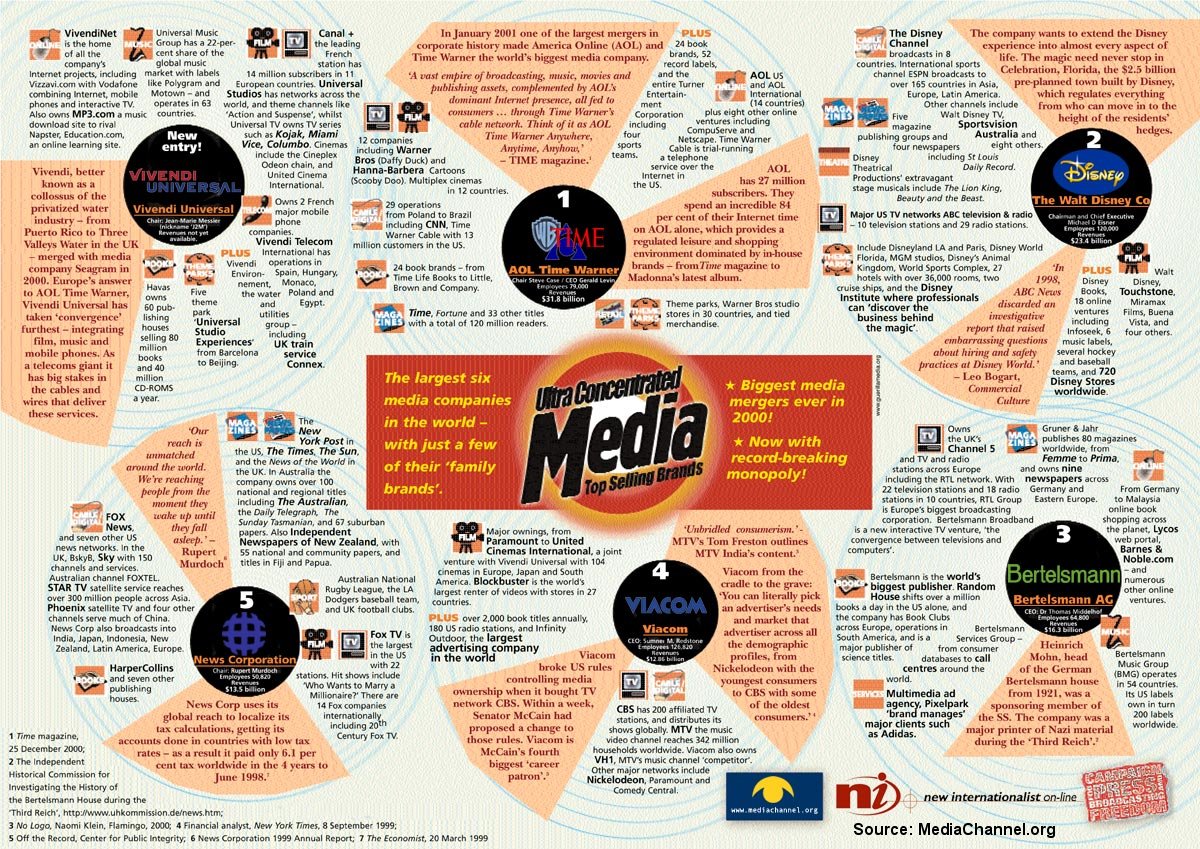
Media conglomerates
Wikipedia defines media conglomerate as "a company that owns large numbers of companies in various mass media such as television, radio, publishin, movies and the Inernet". And even though sometimes is not the most reliable source it is quite an accurate definition.
Henry Jenkins says in The cultural logic media convergence that "the new media conglomerates have controlling interests across the entire entertainment industry" and that's something that we can see every day. Companies like Berlusconi's Fininvest own TV channels (in different countries), publishing and advertising companies, and even a Football team, AC Milan. So...the group basically has every division in media management. They have the product to sell, the advertising company that will help them sell it and the network where to show it. They don't need anyone else.
He also says that "convergence is both a top-down corporate-driven process and a bottom-up consumer-driven process". We're witnessing how few media companies own most of the media content but also how people are creating their own content and becoming really succesfull. Keenan Cahill (here with David Guetta) is one of those ones. He uploaded videos making covers and became famous worldwide. Even 50 cent made a video with him and received millions of hits! And I'm not saying I like 50 cent (which I don't) but just that he became as famous himself as the artists he was covering.
As Mark Deuze says in his article "online, media participation can be seen as the defining characteristic of the Internet in terms of its hyperlinked, interactive and networked infrastructure and digital culture". And, again, there are millions of examples of this.
I don't know where are we heading into...but I'm sure that media companies will have to be aware of the appearance of Internet stars and be ready for a change of its structure. Some TV channels have already started to hire youtube celebrities and made a show designed for them (f.e:make-up artist in Spain: Isasaweis). The present and future is on the net and it's with it with the one companies will have to deal.
Suscribirse a:
Entradas (Atom)