martes, 25 de octubre de 2011

Internet of things and goodbye!


The Internet of Things is something that I had never thought about but since the video that we saw in the lecture, the one of Ericsson and the guy talking to his home via a social network, I have been thinking about it. And it freaks me out a bit.

I could imagine myself in the position of the guy, "talking" to every single object of my house, giving me so many details about everything...so much information that I don't need to know! So what if I haven't vacuumed the floor for the last 143 hours? It's something that I should decide when to do and have to think about it, not the objects thinking for me, making decisions for me.

Someone in class raised the question about hackers intrusion in this world. And it is an interesting question. What would happen if your neighbor doesn't like you and decides to hack your home account and set your house on fire?!?! Or cook for you. Or change the TV channel while you're watching something...or just drive you crazy with every single device at your place?!It's nuts.

And about the Toyota cars talking to each other...I can't help but laugh at it. And in a few years, or not even that long, I might look back and see how wrong I was. But for now I just find it nonsense cars being friends and that kind of things. Ok, the tires are a bit low, the car can tell me that, but I don't need it to tell me if there is a gas station x km away and that I should stop there. I still wanna think. I feel that with the "Internet of things", we are driving into a life of efortless thinking or no-thinking at all.

It has been a fun semester. I guess I might see you around next semester :)


Goodbye to you all!


viernes, 21 de octubre de 2011

Apple Vs. Google


Like many of you, I'm an Apple person. Not that I have many devices, just a MacBook and an iPod, but I definitely like the way they do things. They have me. I remember that at first, when I bought the MacBook, I got lost all the time and wondered why had I purchased it but after a few days I realized that it was way easier to use than a Pc. And I don't think I'm ever going back to Pc-but you never know...

The case of mobile phones is different...We've got dozens of companies using an open system, Android, and one single company-Apple- using a closed system, ios. And even though Android is becoming stronger every single minute, I cannot forget that it's lots of companies fighting agains just one. It's one system against another one, ok, but still...if we think in terms of companies...Apple is the absolute winner.

Kathleen says that she was planning to buy an iPhone when going back home but now she might have changed her mind and go for an Android. We've talked about the open system advantages and it really sounds tempting but I would still go for an iPhone. It's more expensive and closed but it is easy for me to use, I can syncronize it with my MacBook and it is safe. I know that if I download an application I won't be receiving any kind of virus or something that I haven't asked for. I go for comfort.

By the way, I found this fun infographic on profile of a self-described Mac person vs. Pc person. I must say that I agree on some of Mac's aspects (stronger verbal vs. math aptitude, I would rather ride a Vespa, The Office IS the funniest TV show and I prefer indie-or european- films)


viernes, 14 de octubre de 2011

Social media and Revolutions


Revolution: is a fundamental change in power or organizational structures that takes place in a relatively short period of time. Revolutions have occurred through human history and vary widely in terms of methods, duration, and motivating ideology. Their results include major changes in culture, economy, and socio-political institutions. (Wikipedia).

So, how have Facebook and Twitter helped to the development of the Arab Spring? To me, they are tools, really powerful ones, but just that. They are not THE revolution itself. They belong to a different one, a technological one, not a political one.

I guess I belong to that group of people who think that social media systems just helped people gather together and raise their voices as one. Groups of people that thought they were few but, thanks to these tools, they found out they were more and had more power than could ever imagine.

I'm aware that it would have been harder without these technologies but not impossible. Portugal's Carnation Revolution in April 1974 made it possible to change from an authoritarian regime to a democracy. And it was the military to start it but the society followed them. It was peaceful and it was still a revolution. Despite what some people might say...it is possible to make a big change without violence.


Twitter and Facebook are a technology revolution, yes. But just a tool to a political revolution. People will always find the way to fight governments and injustice, no matter if they have to use a fax, Twitter, Blackberries (if their service works, of course) or a Tam Tam. There's always a new invention for every political revolution. Always.

#ArabSpring #mena #spanishrevolution #londonriots #democraciarealya #occupywallstreet #occupyboston

viernes, 30 de septiembre de 2011

Online activism

So...is online activism/hacktivism the future? Or is it already the present?
I think that online activism has been being developed for several years but has grown strong after the appearance of social networks, which made it possible to gather people together and raise a voice agains the wrongdoings of governments and politicians. I just have to remember that in the already mentioned Spanish movement people would meet in the streets in small communities and discuss about things that affected the neighborhood.

And what about e-democracy? Is it a real possibility and how can we manage to do it properly? As said in James Cabree's article, Civic hacking: a new agenda for e-democracy, "This should be the ethic of e-democracy: mutual-aid and self-help among citizens, helping to overcome civic problems", and I agree with that. It has to be easy and resolve people's problems the best way possible, without much bureaucrazy and with the sense of community. But I think that we will have to wait a few years to see this idea as an everyday reality.

With the appearance of Julian Assange and Wikileaks, the world faces new challenges. Are we sure that we want to know all the truth? Is it safe for citizens to know every single thing that governments do? And what has happened with investigative journalism?

I know that I want to know it. And most people want to know too. So now the source is Wikileaks, a source that decodes files and has them from various different secret sources. And, are all of them reliable? We should believe they are. If they weren't, governments wouldn't be as worried as they are with Assange and its hackers. But we had investigative journalism before the arrival of this so, what's the difference? Well, first of all, Wikileaks has no corporate interests that media companies have and the information that they publish comes they way they receive it. News companies transform the information according to their editorial line. It is a much more biased information.


I post again the Timeline of the Arab Spring to show how social networks can help people gather together and change their political systems.

viernes, 16 de septiembre de 2011

Citizen Journalism and Twitter

So...Citizen Journalism is described as "the concept of members of the public playing an active role in the process of collecting, reporting, analyzing and disseminating news and information". The US National Association of Citizen Journalists defines the concept via Jay Rosen, Professor of Journalism at NYU:


<

So my question is...why do we even bother reading newspapers? Where's the difference between newspapers and citizen journalism? I am still a bit skeptical about the appearance of citizen journalism. As a student of this field, a future journalist, why do I even bother studying it when I could instead be in the streets with my phone, looking for "the news"?

I know that Twitter is one of the greatest tools of social communication but, has it become the main source of information? We had the best examples in the Arab Spring earlier this year. Lots of tweets every second describing what was going on while TV channels and radio stations struggled to get information the traditional way. And I agree with you that it was amazing that truth could be told without any economic or political interests in between. Just people saying and uploading videos and pictures of what was going on.

But can you trust any anonymous source? Do we know where every personal message comes from? Most of the times we don't know bloggers' backgrounds, if they belong to any organisation, religion or are the ones creating the news. And...if they lie, what's their punishment? Do they have any? Because if any traditional media makes a mistake or lies...they are no longer trusted by their audience and lose the battle for the ratings (which is sometimes truth's biggest enemy).

And about Twitter...I like it, I do. I don't post many details of my everyday life. I mostly post music recommendations or retweet interesting links or sayings. But there's people who still don't understand the benefits of it and just tweet valueless things. Valueless for me, of course. But, in order to make Twitter a useful tool, everyone should know how to use it the "right way". As instantaneous as it is...sometimes is dangerous too. Dozens of celebrities have been "killed" in Twitter. That's why traditional Journalism is useful: because they have to contrast their sources. But, sometimes, they don't. And commit the same mistakes as citizen journalists.

viernes, 9 de septiembre de 2011

The "Long Tail" in the music world


In Andersen's article, The Long Tail, he says that "popularity no longer has a monopoly on profitability", and the first thing that pops into my mind to exemplify it is music festivals. Suddenly, mainstream music is not the only one avaliable to see live. Small bands, and not so small ones, are playing every week in many different festivals all over the globe. And, of course that Lady Gaga sells out the day her tickets go out, but the good thing is that everyone has a chance, a niche market, which I personally think is not as small as they try to make us believe.

Now, the so-called "small" audiences have the opportunity to show their power. Their buyer power. As said in the text, "you need both ends of the curve (80/20)". And, as discussed in class/tutorial, that's one of the reasons of Amazon's success. They have not only hits but also collectibles, rare, independent or old CD's (books, comics...) that are hard to find in traditional stores. I'm one of those 20% who still buys rare CD's, or not so rare, and I have a feeling that most of the people who buy music nowadays are more interested in non-mainstream music. Because it's music we listen because we want to, music we care about. Not Britney Spears or Justin Bieber. We (or at least me) tend to download it because we (or me, again) don't care. That's not music. What do you think?

I don't know if many of you, aussies, have heard about Spotify, but it is one of the options that Andersen talk about in his "Rule 2: cut the prices in half. Now lower it". Spotify is a music streaming service that can be free, having a radio-style advertising every 4-5 songs, or you can pay a monthly subscription wihtout any ads. There's music from most of the record labels, major and independent, and all kind of artists (some of the biggest, well-known bands are not avaliable: no Beatles, Oasis or Bob Dylan). It also has a non-online service, so that you can listen to Spotify while not having/being able to use Internet. Will this platform beat iTunes?


It has recently arrived to the US and it is avaliable in most of the European countries. When will Australia get to know it?


jueves, 1 de septiembre de 2011

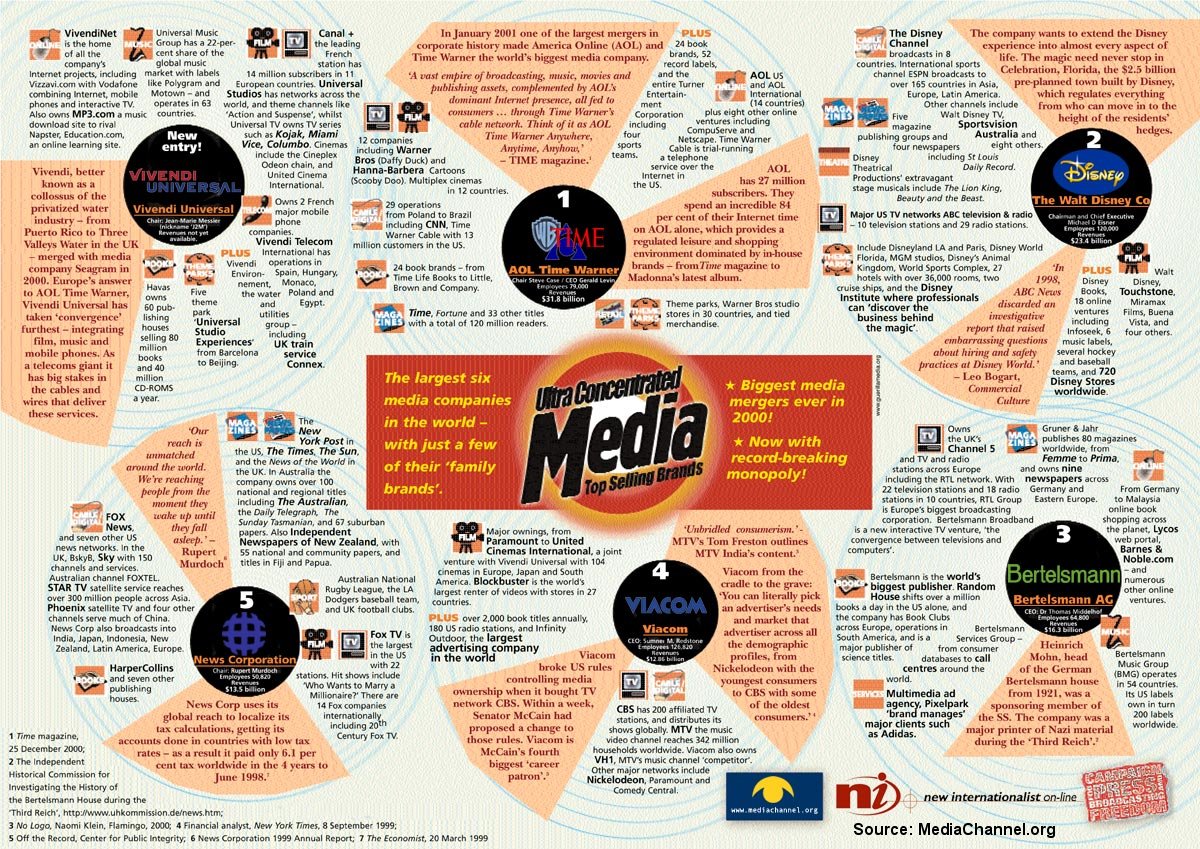
Media conglomerates


Wikipedia defines media conglomerate as "a company that owns large numbers of companies in various mass media such as television, radio, publishin, movies and the Inernet". And even though sometimes is not the most reliable source it is quite an accurate definition.

Henry Jenkins says in The cultural logic media convergence that "the new media conglomerates have controlling interests across the entire entertainment industry" and that's something that we can see every day. Companies like Berlusconi's Fininvest own TV channels (in different countries), publishing and advertising companies, and even a Football team, AC Milan. So...the group basically has every division in media management. They have the product to sell, the advertising company that will help them sell it and the network where to show it. They don't need anyone else.

He also says that "convergence is both a top-down corporate-driven process and a bottom-up consumer-driven process". We're witnessing how few media companies own most of the media content but also how people are creating their own content and becoming really succesfull. Keenan Cahill (here with David Guetta) is one of those ones. He uploaded videos making covers and became famous worldwide. Even 50 cent made a video with him and received millions of hits! And I'm not saying I like 50 cent (which I don't) but just that he became as famous himself as the artists he was covering.

As Mark Deuze says in his article "online, media participation can be seen as the defining characteristic of the Internet in terms of its hyperlinked, interactive and networked infrastructure and digital culture". And, again, there are millions of examples of this.

I don't know where are we heading into...but I'm sure that media companies will have to be aware of the appearance of Internet stars and be ready for a change of its structure. Some TV channels have already started to hire youtube celebrities and made a show designed for them (f.e:make-up artist in Spain: Isasaweis). The present and future is on the net and it's with it with the one companies will have to deal.


jueves, 25 de agosto de 2011

Copyright vs. Copyleft


It's curious how things change for somebody's own benefit. Walt Disney started its success by copying some of the features of Buster Keaton's "Steamoat Bill" and, if I remember correctly, it was the first company to ask for Copyright.

I don't know how do australian laws work but in Spain we have a very particular system. In the past few years there's been a national discussion about what to do with intellectual property. Should it be legal to download every single song or movie?What about those authors who are not well known for most of the audience?

So the Government decided to give special power to a private society: SGAE (Sociedad General de Autores = Author's Society). They would charge a percentage/canon for every single virgin CD/DVD, every song played on the radio/TV, songs played in restaurants and bars, for every copying device, DVD players, and so on.

So, in the case of CD's and DVD's, the SGAE collected money by arguing that someone could record any copyright material in them. To me it's like if you could put a person in probation because they bought a knife and...who knows what could they do with it!

So what many shops and bars have decided to do is put Copyleft music so no one could charge them. And many artists (spanish Nacho Vegas) are selling, or giving away, their music as Copyleft and it's been a success for them. They are playing live more than ever and earning the same amount of money as before. The ones to lose: music companies, not bands. But copyright is about creativity and ownership, as the US copyright policy says: copyright is to promote the progress of science and useful arts, so companies should think about rebuilding their industry.

Small explanation of Copyright vs. Copyleft

lunes, 15 de agosto de 2011

Are we aware of how our future might be?


These week's readings are making me think. Think about my possible/most likely future and think about my uncle's and my former boss life.

My uncle is an executive TV producer and he has been recieving calls, work calls, every weekend since I was a little girl. And Internet was still small but getting stronger when all these work calls started. I couldn't understand why would he be on a sunday afternoon/evening answering these calls instead of turning off the phone and just let the voicemail do its work. And, even worse, two years ago, while New Year's Eve dinner...a colleague from work was texting him asking for some work issues!!!On NEW YEAR'S EVE!!

The concept of 'presence bleed' of Function creep article describes perfectly what people are starting to get used to and see it as 'normal', to see work as non-work but just 'e-mail checking' amongs some other things. And one of its' effects is, as written in this paper, "a growing amount of "environmental stress" in the work place". And again, another person pops into mi mind.

My former boss, also the best boss anyone could imagine, would live connected permanently. Of course, her work is related to information and communication, but still, is it really necessary to be connected 24 hours a day? She would sleep, of course, but the first thing she would do was turn on the computer, check twitter, e-mail, send some work updates before going "to work" and will repeat the process when she got home. And she did a wonderful job, but is this the life that we are expected to live? Being 24/7 avaliable for our bosses and having little time to spend with our -future- kids, enjoy an evening at the movies without thinking "oh,i have to tweet this for work""i have to write this e-mail to the office in Los Angeles"... At least her case wasn't as severe as the woman from the text, the one who said she couldn't even go to the gym. I'm not sure but I think my boss won the office's paddle tournament (a sport that only seems to be played in Spain; somehow similar to tennis/squash)!! So yeah, she's the best.

But still, I think that people, specially the ones involved in the media industry or the internal communications department of any company, depend more and more on their Blackberries/iPhones/Android phones and they would drive mad if something went wrong for more than 10 minutes. But, is there something SO important that can't wait even 1 hour?2 hours?2 days? Of course, the insecurity of losing your job is the main reason for being connected all the time but if we're always avaliable...will we still be avaliable for our family?for our friends?for living? you should work to be able to live, not live to be able to work.

That's why I'm thinking on making money and then just retire in a desert island. Have my own bar and sell a few drinks a day. No stress. Just a hammock and the sun. Wouldn't it be nice?

viernes, 12 de agosto de 2011

Cyberspace identity


Barlow states in his "Declaration of the Independence of Cyberspace" that "our identities have no boides, so, unlike you, we cannot obtain order by physical coercion". But, who created and lives the Cyberspace if not humans? And don't humans and their computers leave some kind of trace? (TCP/IP)

17 years ago, when this declaration was written, it seemed that the net would allow people to be anonimous. But this has been proven wrong. We can try to be anonimous and make comments without using our real names but it is easy to follow the data trace that every computer leaves behind. It's true that it's easier to hide on the net than in real life and it's still hard to be found, but not impossible. If they can show you advertisements from the place you are connected to Internet, how come can it be hard dor the Police/some-other-person to find you?

Banks or online stores have access to a lot of data when you purchase something on their webs or do some kind of transaction. Everything is kept and there's no way out. We have to pay for the ADSL and phone bill, we have an IP address for that bill and our credit cards can tell our Bank what we buy, where and how much we spend. So...does anyone still think that we are completely anonimous?

Barlow also mentions that "your legal concepts of property, expression, identity, movement and context do not apply to us" because they are based on matter that doesn't exist in Cyberspace. This is not completely true. They might not be the same concepts and it may not be physical matter but there's cyber-matter (if it could be called like that). Every person who publishes or posts something under his real name or pseudonym has the property and it's responsible for that material. Even though that post is "nowhere and everywhere", it is alive on the net, so it somehow exists.


In this week's readings also found interesting the appearance of a new word: prosuming. In "New rules for the New Economy", Kevin Kelly declares that "in the network economy, producing and consuming fuse into a single verb: prosuming". I had never heard about it and I think it's a sign of the way economy and society is changing.

And it's happening the same in the Internet. Anyone can be the author of some information and consume some other information. A few years ago we didn't have the possibility to be heard if we were not politicians or journalists mainly, but now we can. Blogs, like these ones that we are writing, allow people to speak their minds, be a bit more free and, sometimes, say things they wouldn't say in their everyday lives.


viernes, 5 de agosto de 2011

Social movements


I wake up every morning and the first thing I do is turn my computer on and read the newspaper. A spanish newspaper.

If we went back only 20 years, this would seem impossible to do. But nowadays, I'm sure we wouldn't manage to live without online international news.

I happen to be spanish. I don't know if many of you have heard about the Spanish Revolution, but it started in may 2011 and it's still going on. Mainly in the capital of the country, Madrid, and Barcelona, the second biggest city. How did it all start? Some people, tired of politicians and the way the government is managing the huge crisis that Spain is suffering, started to talk about it online. Twitter, Facebook, Tuenti (a spanish social network very similar to Facebook) suddenly became the tools to make everyone join at one place. At first they were few, but the message expanded rapidly and every day there were more and more "indignados" (angry because of the system).

This is how "la puerta del Sol" -city centre of Madrid- looked like in may:


Could this have happened without the help of social networks? Of global networks?

People used to think that there was no way to fight against the established power but...is that premise still valid? People have find a way to be heard and to be noticed. We are not puppets anymore.

This movement, known as "Democracia Real Ya" - Real Democracy Now- was in every spanish city and all over the spanish embassies during the months of may and till the 15 of june. It expanded and started a similar movement in Greece. It may seem that it has ended, but it's not. It's still alive and will keep on living thanks to Internet. The network of networks.

I started talking about newspapers because I wanted to talk about this movement and how things have changed. The economic situation of my country scares me more every day. I've been reading terrible predictions about what could happen and I could do it because of the global system that we live in. Even though I'm 20.000 km away from home, I can feel what's going on, I can feel that people are terrified because they don't know what's gonna happen. We could be the next ones needing to be saved. And, of course, not the last ones. Europe would...how to say this...be over.

That's global networks. If one gets affected, be careful...you could be next.

I don't really know what I wanted to say with this but I'm just scared. Don't hear any good news.

lunes, 25 de julio de 2011

Starting at UOW

So...my name is Antia, I'm 22 and I am an exchange student who has just arrived from Spain. I study Journalism back home and, hopefully, will finish my degree this semester.

I am currently living in Campus East-and loving it-and been here only for one week. But I have already been to the 'party bus', with its coloured lights and party music. I have also been to Sydney and Fairy Meadow beach and can't wait for summer to arrive. It was 30C in Spain so...yeah, I'm all day freezing. Don't have a heater. Need to buy one.

I come from two different cities of Spain. One of them is San Sebastian-the most beautiful city of the country, and also the most expensive one-, 30 km from France


and the other one is Santiago de Compostela, close to the Atlantic Ocean. Also beautiful but in a different way.


This is me! Well, at least a part of me. See you in class :)